
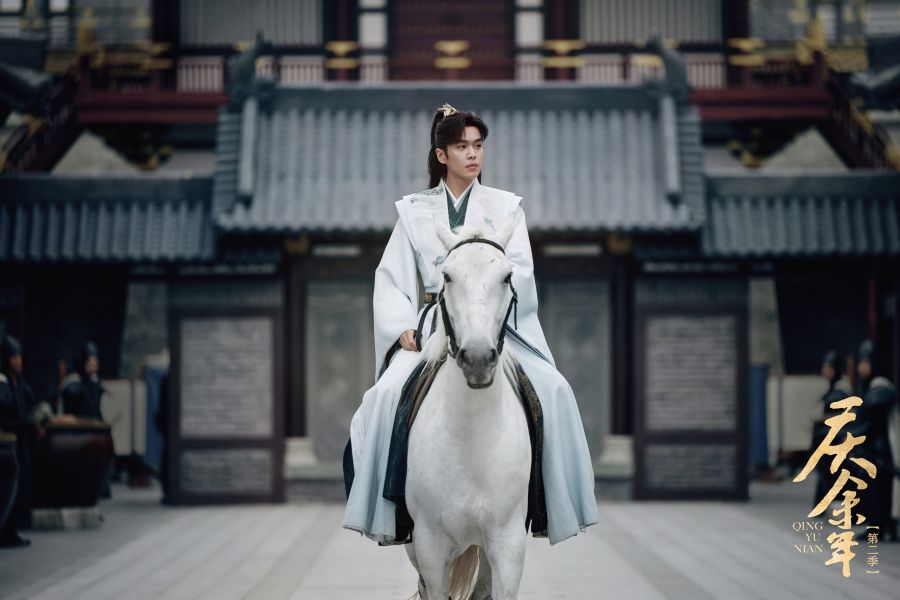
Episode 29 is action packed as Fan Xian and the rest of the capital head to the Hanging Temple for the Chrysanthemum viewing party. At the end of episode 28, Fan Xian is escorted by Gong Dian, head of the Imperial Guard to bring potted flowers up to the temple. As they walk up this rather precarious structure, Fan Xian asks whether or not it’s safe here. Probably would be a good spot for an assassination. Gong Dian responds that it’s exceptionally safe. Which means…there’s going to be an assassination! Haha
He places the specific pot of flowers he is carrying down and actually moved to a specific spot for HIS pot of flowers. But as they get ready to head out, Fan Xian immediately runs and scales to the rooftop. He thought he heard footsteps but Gong Dian, who chased after him, couldn’t see or hear anything. After surveying the scene and not seeing anything, they depart. Only for the camera to pan to a black silhouette on the rooftop shortly after that looks familiar to Wu Zhu.
Soon after, the Emperor calls for the actual festival to happen so Fan Xian heads back officially to the Hanging Temple again along with all other government officials. His carriage is directed towards an expedited route in the midst of a large traffic jam of carriages heading to the temple. Here, he is stopped by a new face, Ye Zhong and his soldiers. Ye Zhong is Ye Ling’er’s father and the Grand Commandant of the Capital as well as the older martial brother to Gong Dian. Right off the bat after introductions, Ye Zhong requests to spar one fist with Fan Xian. He does so but then all tension dissipates. Instead, Ye Zhong pulls Fan Xian aside and even tries to bribe him with a wad of a check to request for Fan Xian’s help in protecting the interior of the Hanging temple from any threats. Fan Xian is rather amused by this and point blank asks if he Ye Zhong rarely does it to which Ye Zhong confesses this is his first time bribing someone. Fan Xian just chuckles. He agrees to keep an eye out but doesn’t think anything amiss will happen. He heads off to the temple.
Originally, Fan Xian was not going to climb up the tower. He wasn’t interested and also does not care for how each tier of the temple is slated for a certain level of rank at court. But, that wasn’t really up to him to stay on the ground floor because soon after, shouts rang out of a fire. Smoke started billowing out from the temple and Fan Xian immediately jumped into action. He ran over to where the smoke was and Ye Zhong instructed him to hurry up to protect the Emperor. Without a second thought, Fan Xian vertically scales the cliffs towards the top floor in search of the Emperor.
Funnily enough, when he got to the top of the temple and shouted his arrival, the Emperor was like “why are you here?” “There’s a fire” “Where is it?” “Extinguished”. LOL. The Emperor was actually more annoyed that Fan Xian was there making a fuss over a fire that didn’t really mean anything. But at least Fan Xian is now at the top floor with the Emperor and the other princes.
He continues to push that given the unknown nature of the fire, there is immediate danger against the Emperor. He urges the Emperor to leave and return to the capital for his safety. The Emperor doesn’t listen and instead turns to the view many many flows down where the chrysanthemums are blooming. He dismisses Fan Xian’s concerns and instead, orders the festivities continue. He wants to watch the flowers with food and drink.
The Emperor orders Fan Xian and the 2nd prince toast away their differences, at least for the moment and takes a seat at the head of the hall. The two young men do so and turn towards the Emperor. However, Fan Xian notices something amiss with one of the soldiers nearby who is sweating profusely. In an instant, the soldier unsheathes his sword and lunges towards the Emperor. Chaos ensues. Fan Xian is able to grab this soldier as everyone starts screaming about an assassin. But it’s not just one assassin. A nearby eunuch also has a hidden dagger that he takes out to strike while a third man in white scales down from the ceiling and points his sword directly towards the Emperor to strike.
There is a LOT going on right here. The man in white, whom the Emperor names as Grandmaster Si Gu Jian’s younger brother, had his sword aimed directly at the Emperor to his left. Problem was, the 3rd prince was directly in front of the Emperor. On the other side of the Emperor, so to his right, was the eunuch with the hidden dagger. Fan Xian made a millisecond decision to help protect/push the 3rd prince out of the way and engaged directly with the swordsman in white. The 1st prince subdued the first soldier assassin while the crown prince recovered from a slip himself and the 2nd prince just drank more alcohol.
Next thing we know, the eunuch that was attacking the Emperor lies dead on the ground next to him. Fan Xian, seeing that there is no additional threat to the Emperor, tears after the swordsman in white. The episode closes with Fan Xian chasing Si Gu Jian’s brother down the cliffs of the mountain, across the chrysanthemum field, through a bamboo forest and into what looks like temple grounds.
We’ll leave the chaos of the Hanging temple here.
The other main thread for the episode which is really just for laughs is Fan SI Zhe’s goodbye. He returned home after the honeymoon excursion having found his life’s purpose which is to open up a bank. Before he leaves though, his dad in particular wants to play a round of Pai Jiu or Chinese dominos which we’ve talked about in the past. Fan Jian doesn’t actually want Fan Si Zhe to leave home and wants to keep him here on the game table. But, Wan’Er shows up and wows everyone with her Pai Jiu skills which, is apparently a skill she learned while all alone growing up in the palace. She ultimately is able to change the results of the game to side with whichever outcome is preferred. Finally, Fan Jian recognizes that it’s time for Fan Si Zhe to grow up to be a man and follow his dreams. WIth that, he says goodbye to the family.
–
This was an action packed episode with a good amount of references to Chinese history, so let’s dive into them.
First and foremost, let’s talk about the history of 赏菊 or Chrysanthemum viewing.
As I mentioned in the previous episode, Chrysanthemums have had an important place in Chinese culture and history dating back over 3000 years ago. The Book of Rites states: “鸿雁来…鞠(菊)有黄华 – When the wild geese arrive… the chrysanthemum has yellow blossoms. Chrysanthemums generally bloom from late summer through late fall, typically between August and November, which aligns with when the wild geese arrive.
That timing then aligns very nicely with the Double Ninth Festival (the ninth day of the ninth lunar month) or 重阳节. This means this festival falls right in late fall. The festival, which we’ve talked about previously on our podcast, celebrates a bountiful harvest, wishing longevity to elders, and in general is a day to pay respect and love to the elders. In China, chrysanthemums also symbolize longevity and resilience and so they are often called the “Longevity Flower.” Therefore, Chrysanthemums play a huge role during the Double Ninth Festival.
This association began in the Han and Wei Dynasties, some 2000 years ago. During the Double Ninth festival, people climbed mountains, drank chrysanthemum wine, and wore dogwood sprigs. By the Tang and Song dynasties, admiring chrysanthemums during the Double Ninth Festival had become a widespread tradition. During the Song dynasty, chrysanthemum cultivation flourished with numerous cultivated varieties, becoming a major activity among urban residents to grow and admire the varieties. The Ming and Qing dynasties continued this tradition with large chrysanthemum exhibitions, including displays such as building “chrysanthemum mountains” or “flower cities”. The major metropolitan hubs such as Beijing and Suzhou hosted chrysanthemum events on a considerable scale.
Today people still celebrate the Double Ninth Festival but not to a wide scale. Chrysanthemums are still very popular, obviously with tea, but I wouldn’t say there are large scale “Chrysanthemum cities” for display.
Connecting this back to the drama, having a Chrysanthemum viewing festival IS rather standard. Although, it is season dependent, so the emperor saying he’ll have the festival whenever he feels like it, is a stretch.
Now let’s move onto the very impressive temple that all of court has to climb in order to enjoy the Chrysanthemums.
In the book, the place is called 悬空庙. I did a little digging on the filming location or at least the inspiration for the set in the drama.
It looks like the drama at least filmed a little bit OR was inspired by the 江南悬空寺 or the Jiang Nang Hanging Temple. This temple is located in the 大慈Daci Rock Scenic Area which also boasts gorgeous canyon streams, and the “largest natural standing Buddha in China.” The cliffside cave architecture is one of Daci Rock’s most distinctive features and features the “Jiangnan Hanging Temple.”
According to legend, during the Yuan dynasty (1297–1307), the founding monk 莫子渊 Mo Ziyuan, also known as Daci, left his home in Lin’an 临安 after a spiritual vision and came to this location. He carved Buddha statues from stone and built a temple along the cliff. The mountain later became known as Jiande Daci Rock because of this association.
Half of the temple complex is embedded in the rock face, while the other half extends outward over sheer cliffs. Its architectural style closely resembles the Hanging Temple of Mount Heng in Shanxi and that’s why it’s called the “Jiangnan Hanging Temple.” That’s right! There are 2 hanging temples in China in which a temple is built on the side of a cliff! Anyways, this one in Da Ci makes full use of high cliffside caves, while its halls, walkways, corridors, and cableways all appear to hang in midair. The main Dizang Hall is partly embedded in rock and partly suspended, creating a breathtaking and dramatic structure. Now as I look closer, I don’t think the drama actually filmed here because the structure in the drama is MUCH sturdier. Both Hanging temples are now tourist attractions that you can go and visit! I’m looking at photos of both and I’m honestly at a loss at how these were built like 800 years ago.
Next, Fan Xian meets Ye Zhong, the 京都守备. He is the Military Commander of the Capital. In the drama, he tells Fan Xian that he’s in charge of the protection and safety of the capital.
守备 was an official military title during both the Ming and Qing dynasties. In general, it referred to a military officer responsible for defending and garrisoning cities and towns. The position oversaw camp administration, including the management of provisions and military pay. However, I don’t think there was a specific 京都守备 during the Ming and Qing Dynasties as in that was the title for the capital commander. There were other bureaus and military offices that held these responsibilities such as 九门提督 the Nine Gates Infantry.
In the drama, Ye Zhong is jokingly trying to bribe Fan Xian to protect the emperor and loudly gesturing that if anything happens to the emperor then his men are the first to get punished. Ye Chong is like – you know that phrase when there’s a big wind, the wind blows all the nameless people. Fan Xian responds with the correct idiom but is also like…this is the wrong idiom.
So what’s the idiom? Fan Xian says 风起青蘋之末 or A breeze arises from the tip of green duckweed.
This originates from 宋玉 Song Yu’s 风赋 Ode to the Wind during the Warring States period. Song Yu (298–222 BCE) was a poet and politician from the Kingdom of Chu during the Warring States period. He served 楚顷襄王 King Qingxiang of Chuduring his life. In the Ode to the Wind, Song Yu uses the nature of wind to write a dialogue between himself and the king, contrasting the benefits and costs of wind as metaphor for how events will play out.
In the original text, the phrase is 夫风生于地,起于青𬞟之末 or “Wind is born from the earth and rises from the tips of green duckweed”. The text describes how wind begins at the tips of duckweed leaves before growing into strong gusts. In history, this phrase has also been shortened to just 青𬞟之末 or the tips of green duckweek. It refers to major influences or social trends originating from subtle or overlooked beginnings. It is often used to describe great events that arose from humble beginnings, emphasizing the importance of observing small signs that foreshadow larger developments.
Now that we’ve discussed the meaning of the phrase, I agree with Fan Xian! This phrase has nothing to do with Ye Zhong’s men but I COULD see the argument that Ye Zhong doesn’t want to miss small details because it might lead to larger consequences.
–
Lastly, let’s conclude with a poem that the Emperor himself recites right before all the chaos of the assassination.
He recites these two lines. 不是花中偏爱菊,此花开尽更无花
The full poem goes as such
秋丛绕舍似陶家,遍绕篱边日渐斜。
不是花中偏爱菊,此花开尽更无花.
Here’s my translation. Clusters of autumn chrysanthemums surround the house, like that of Tao Yuan Ming’s house. As I wander around the fence, the sun slowly sets
It is not that I favor chrysanthemums above all flowers, It is because when they finish blooming, No others remain.
Remember earlier when I said Chrysanthemums have had a LONG history in China? Here is one prime example.
This poem is simply titled “Chrysanthemum”. It was written by Tang dynasty poet Yuan Zhen 元稹 around 802 CE in 长安. One of his other poems was featured in season 1. Yuan Zhen was a politician, poet, and scholar who rose through the civil service examinations and served as an imperial censor. After suffering political setbacks and exile, he later returned to high office. His surviving works include over 830 poems compiled in Collected Works of Yuan Zhen.
This poem is one more “bug” in the drama. Technically the Emperor should NOT know this poem because the poet 元稹 should not exist especially since Fan Xian recited another poem of his in the previous season and no one heard of that poem before.
–
Let’s conclude with book differences!
It’s time for the Chrysanthemum viewing event. In the book, the author notes that Chrysanthemums are fairly common. 澹菊花茶 or Chrysanthemum tea from his hometown of Dan Zhou is very popular throughout the kingdom. The purpose of the Chrysanthemum viewing event is actually to bring all the royal family members together to strengthen relationships. That means the Empress dowager, the empress, and the other consorts are here too. At this point, the 2nd prince is still “grounded” so he and Li Hong Cheng aren’t in attendance. The assassination attempt follows pretty closely to the book, including the fire before the actual attempt. We’ll have to see the next episode on what happens with the assassin. On another note, Fan Si Zhe doesn’t have this whole going away party because well, he was sent up north to the Northern Qi Kingdom after all the events of Bao Yue Lou and didn’t return for a long while. The drama gives the character a lot of growth including realizing that he has a life mission to better the people of the kingdom rather than JUST make money. The drama here also tries to give Wan Er more to do so at least there’s some effort.