
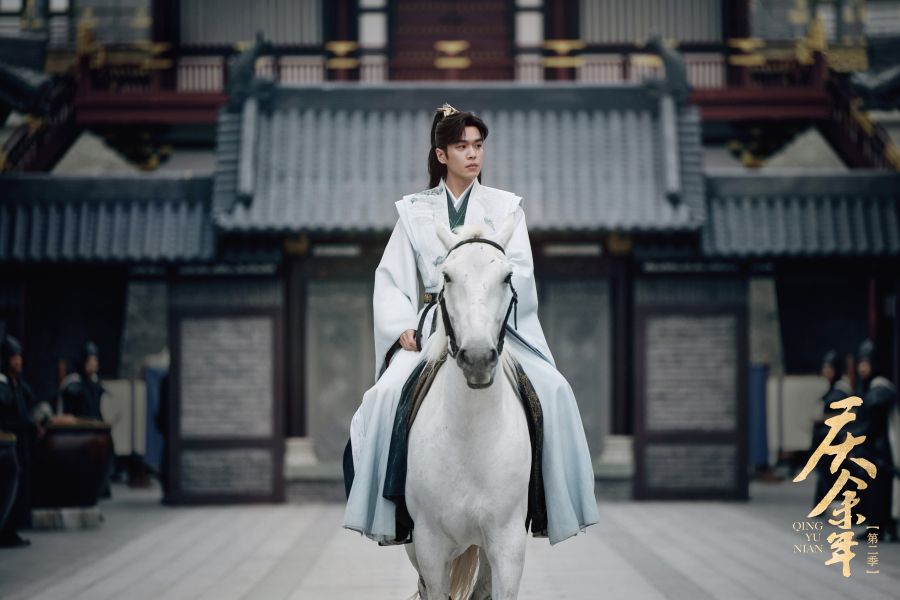
[Karen]
Today is Fan Xian’s first day at court! He is here because the guys at the Censorate are super pissed off at Fan Xian who basically added fuel to the fire and called them not only dogs, but corrupt as hell. The Censorate is supposed to be a group of very upstanding people who care more about their reputations than all else so they were not about to let Fan Xian talk to them like that. Plus Fan Xian DID take 3000 taels of silver from the Crop Inspection Bureau so they were going to nail Fan Xian for corruption.
Fan Xian, though, is taking it in stride. We open episode 10 with Fan Xian in the main hall as everyone is gathering before the Emperor arrives. He is with his old buddy Xin Qi Wu who is giving Fan Xian the lay of the land.
There are 3 people at Court who are are given special permission to “Sit” by the Emperor. That means they are of the utmost importance in terms of rankings at court and you could consider that they even outrank the Crown Prince who must stand. The first person we meet is actually rather peculiar. He is an older gentleman who already arrived but is snoring quite loudly in his chair. We learn that he is the highest ranking military member at court, General Qin.
The second and 3rd people with “sitting” honor are people Fan Xian knows. 1 is his future father-in-law, the Chancellor Lin Ruo Fu, and 1 is his boss/uncle, Chen Ping Ping. He look, Chen Ping Ping is on Fan Xian’s side because of his mom but Lin Ruo Fu likes Fan Xian for him. He has 2 of the most powerful people at court supporting him? That’s called good networking.
[Cathy]
What is odd though is that while these three men are given “seats”, well 2 and Chen Ping Ping is in his wheelchair, the Emperor doesn’t have his dragon throne which is customary of Emperors. Xin Qi Wu explains that the Emperor thinks the throne is uncomfortable so got rid of it.
The last “new” person Fan XIan meets is 左都御史 Lai Ming Cheng or the Left Censor in Chief who essentially co-runs the Agency. He introduces himself to Fan Xian as a way of assessing him before their showdown. Fan Xian continues to be rather nonchalant and doesn’t seem too fussed about what’s about to happen next.
It is now time for the Emperor to arrive. And man, very few people can hold a candle to the aura that emanates from actor Chen Dao Ming when he walks up the hall. The way he walks just signals that he is in power. His stride, how his hands are held with one near his hip. Chen Dao Ming is always on the list of the best actors who acted Emperors or princes and this one scene is another reason why he is such a great “Emperor” actor. Interestingly, he doesn’t sit stick straight. He instead I think has a leg crossed on his non dragon throne throne. But his aura is still palpable that he continues to “command” the room despite his more relaxed sitting posture. Not only that, notice how he doesn’t wear a robe with dragons embroidered onto it. In China, Emperors almost ALWAYS wore dragon embroidered robes. The fact that he isn’t and is also wearing black rather than gold, speaks to again, how he is not necessarily focused on the signal of the “dragon”.
[Karen]
Now is where the fun starts and this scene reminds me of all the hidden meanings behind banter in Empresses in the Palace.. Lai Ming Cheng is ordered to step forth to provide his charge. He claims that Fan Xian publicly took funds which equates to corruption. Fan Xian is unfazed and continuously denies that this ever happened even in the face of written testimony. Eunuch Dai of the Crop Inspection Bureau is then called to the main hall.
Dai Gong Gong is dragged to court where he is shaking all over. Lai Ming Cheng gives him the written memo detailing Eunuch Dai and Fan Xian’s corrupt exchange. Here, notice how Fan Xian doesn’t try to defend himself. Instead, he steps forward and puts the pressure on Dai Gong Gong. To add fuel to the fire, he claims that hey, it’s just 3000 taels of silver, not a big number. Dai Gong Gong should be juuust fine. This immediately prompts Lai Ming Cheng to come forth with another written memo which details all of the deplorable and corrupt tasks Dai Gong Gong and the Crop Inspection Bureau has been involved in that resulted in people needing to sell their children to repay their debts. In front of this detailed evidence, Dai Gong Gong cries out that he is wrong and will sell all of his assets to repay for his crimes.
In probably one of THE most chilling sentences I have ever heard in any Chinese drama, the Emperor just says 4 words. 灰飞烟灭。 Do you KNOW what that means? We often hear hui fei yan mie in Fantasy dramas where a god or demon or something is turned to dust and will never reincarnate. That just happens in those types of dramas. Hui Fei Yan Mie more or less translates to turn to dust or reduce to ashes. Just hearing that as a punishment is so brutal. The Emperor didn’t say “off with his head” or “drawn and quartered”. Nope. He said reduce to ashes. I shudder to think how exactly Dai Gong Gong will be reduced to ashes so. Yea. That is definitely one of the worst punishments I can think of. The harshness of that sentence juxtaposes with the unrefined nature of the Emperor’s entire outfit choice and posture but signals how truly powerful and dangerous he is. He sentenced the Eunuch to death with nary a thought.
[Cathy]
Let’s get back to Lai Ming Cheng harping on Fan Xian. Dai Gong Gong is sentenced but Lai Ming Cheng still believes that Fan Xian should also be punished for taking the funds. The camera cuts to other important members of court who I feel are a little exasperated at Lai Ming Cheng because I think it’s obvious to the likes of Chancellor Lin that this was a set up by Fan Xian to root out the corruption by Dai Gong Gon. But Lai Ming Cheng doesn’t know that so he continues to attack Fan Xian.
That’s when Fan Xian responds with something that makes several people tense up. He says “Censor Lai, how can you falsely accuse a prince?”. The immediate thought there is that Fan Xian is claiming himself as a prince and that Lai Ming Cheng is falsely accusing him. The camera pans to the 3 princes in attendance, Chancellor Lin, Chen Ping Ping and Fan Jian who are all shocked to hear this. Only Chen Ping Ping and Fan Jian know the true danger of what Fan Xian said while the others I think are just confused.
However, Fan Xian quickly clarifies by saying that Lai MIng Cheng is falsely accusing the 2nd Prince Li Cheng Ze of aiding and abetting Fan Xian taking bribes. That gives the relevant people a sigh of relief while bringing in the 2nd prince into the fray. As the 2nd prince states in the hall, he WAS there with Fan Xian when Dai Gong Gong gave the bribe but given Fan Xian’s intellect, he didn’t believe Fan Xian would just take the 3000 taels of silver. Hence, the 2nd prince opted to wait and see. We know this is exactly what the 2nd prince was doing but he was also hoping to have an opportunity to bring down FAn Xian at court. Now, however, he cannot do that or else he would implicate himself in allowing Fan XIan to take bribes.
[Karen]
Lai Ming Cheng continues to attack Fan Xian but the tables quickly turn as Fan Xian reveals that even though he took the bribe, he immediately gave the money to Chen Ping Ping and the Overwatch Council to also investigate the Crop Inspection Bureau. Lai Ming Cheng questions why Fan XIan didn’t just explain that in a response memo to which Fan Xian states that there are too many corrupt officials at court such that if he didn’t bring it up in this main forum, the crop inspection bureau would likely not be punished and no one would be able to investigate the true corrupt officials behind the scenes. He, Fan Xian, doesn’t trust anyone.
The matter at hand now is whether or not to investigate these corrupt individuals who could be very powerful and connected and even princes. Lai Ming Cheng steps forth and very righteously claims that he and the Censorate is willing to investigate these individuals. Chen Ping Ping produces another memo with a list of individuals with corrupt actions that he states he and the Overwatch Council do not have the capacity to investigate. Lai Ming Cheng does not back down from this fight and takes over the memo, despite warnings of who could be in it. The primary suspect that is not stated but we see glances back and forth? The 2nd prince.
Notice that at this exact moment when Lai Ming Cheng is shocked to see the list and Chen Ping Ping retreats to his spot in the hall, Lin Ruo Fu moves his body purposefully forward and backwards. Immediately, an official at court steps forward to request that Lai Ming Cheng not step forward with investigating as it could cause trouble for himself. Lai Ming Cheng pushes back and is now more adamant than ever that he and the Censorate are willing to take on this case to root out corruption.
[Cathy]
With a few more individuals at court voicing their approval, the Emperor also approves of Lai Ming Cheng’s investigation. With that, Fan Xian secures his victory. Everyone thought that he would be the one implicated in a corruption scandal but now, the person in the most hot water? The 2nd prince as now the Censorate is launching a full scale investigation on the 2nd prince. As Lin Ruo Fu states after court adjourned, Fan Xian is using Lai MIng Cheng as the weapon to attack the 2nd prince. He is definitely sharp as a tack on all court matters and saw right through what Fan Xian has planned. He even had those other court officials planted to support Fan Xian and is able to roundly deny it because those people are technically in the Crown Prince’s camp. That is quite the masterful stroke. That body motion from the Chancellor at court was the signal for these men to step forward. Funnily enough, poor Crown Prince. Didn’t even know those men were in his camp and is now in hot water with the 2nd prince who thinks the Crown Prince did this on purpose.
Rounding out this rather tense episode is Chancellor Lin chastizing Fan Xian for not visiting Wan’Er yet and urging him to see her soon.
With that, we’ll round out the episode recap. There was a lot happening beneath the surface that like I said, reminded me a lot of Empresses in the Palace. We hadn’t had this type of court battle in quite some time so this was a lot of fun! We did get to see exactly how “powerful” and “sly” the Chancellor is and we’ll analyze him a little bit more in the next episode.
–
[Karen]
This episode was all about Fan Xian’s verbal battle with the Censors. There were a few interesting tidbits of history interspersed in the battle.
First let’s discuss 枢密院 or Commission of Military Affairs. When Fan Xian walks into the main palace hall, he sees an old geezer sleeping on a chair, to which Xin Qi Wu responds that he is Qin Ye, the 枢密正使. He is the Commissioner of Military Affairs who leads the Commission of Military Affairs. This institution was the highest military institution but it went through several evolutions.
During the Tang Dynasty, specifically latter half of the 8th century CE, the office of the 枢密使 or Commissioner of Military Affairs was established. The Commissioner role was held by eunuchs and were responsible for receiving court officials and transmitting imperial orders.
During the Later Liang Kingdom so early 10th century: The role of Shumishi was renamed 崇政使 (“Commissioner of Governance”), held by scholar-officials. They worked under the 崇政院 (Court of Governance) established.
During the Later Tang Kingdom, also the 10th century, the Emperor changed the 崇政院 Chongzhengyuan to the 枢密院 and the 崇政使 back to 枢密使. Power was shared with the Chancellor or Zai Xian but this Commission of Military Affairs focused well, on the military.
[Cathy]
During the Song Dynasty, so 11th century onwards, the Shumiyuan 枢密院 and the Zhongshu Menxia 中书门下 (Secretariat-Chancellery) were jointly called the “Two Bureaus”. The former Shumiyuan handled military matters and the latter managed civil government.
Interestingly, the head officials were typically scholar-officials, with deputies being military men. From Emperor Ningzong’s reign onward, so the early 13th century, it became customary for the chancellor to concurrently hold the Shumishi post.
During the Liao Dynasty, when the Jurchens conquered much of the northern Song land,there was a Northern Shumiyuan and a Southern Shumiyuan. The Northern handled military affairs; the Southern oversaw appointments and transfers of scholar-officials, functioning like a Ministry of Personnel.
During the Yuan Dynasty: The Shumiyuan managed military secrets, border defence, and allocation of palace guards. The crown prince nominally held the title of Shumishi, but real power was with the Deputy Commissioners.
During the Late Yuan / Early Ming period, so think 14th century, Zhu Yuanzhang, when he was still the Prince of Wu, retained the Shumiyuan following Yuan precedent. Once the Ming Dynasty was established, the Shumiyuan was abolished and replaced by the Grand Council of Military Command (大都督府) to oversee the army. This grand council was also abolished in 1380 and the powers were incorporated into the 五军都督府 Five Armies Command and Ministry of War.
For the drama, it’s interesting to see that the commissioner is a general. As I just mentioned in history, from the Tang Dynasty to the Song Dynasty, the commissioner was typically a scholar. It wasn’t until the Yuan Dynasty, ruled by the mongols, was the commissioner a military man. I mean, the crown princes were typically well skilled in combat.
[Karen]
Dragon Throne (龙椅) – Fan Xian in the drama remarks that the Emperor is NOT sitting on a Dragon Throne. Why does he say that? Well typically it refers to this resplendent chair that was used by Chinese emperors and had dragon patterns carved on the chair. This includes the armrests, headrest, and the back rest. The dragon throne was usually placed on the steps of the imperial hall where ministers attended morning court. Typically made of wood, the throne’s armrests were carved with dragon motifs and then lacquered in yellow to the Emperor. In all the palace dramas, when princes are scheming for the throne, they typically say 龙椅 or the Dragon Throne to indicat their ambition. I will say, it doesn’t look all that comfortable.
Finally, let’s discuss the fact that there were 3 individuals who were granted the privilege of sitting at court.
From the Qin Dynasty all the way through the Tang Dynasty, so 3rd century BCE to 10th century CE, the Emperor and court officials would be sitting or else kneeling while interacting with each other. So at court, the Emperor would be at the top of the hall sitting to talk to his officials and the officials would do the same in their respective locations. This changed during the Song Dynasty, when the first emperor thought, hm, i need to show that I have more power over the officials. The second day at court, he pretended that he couldn’t see and ordered the Chancellor to stand up and bring him the memo. While the chancellor stood, a eunuch took his chair away. The chancellor returned to his spot and recognized what the Emperor did and from then on, stood at court to provide his updates. The rest of the court soon followed and that became the custom. However, while inside the palace, if court officials had other business, there were ornate gold lacquered chairs that were available for them to sit on.
[Cathy]
During the Ming Dynasty, the capital moved to Beijing. The Emperor sat inside the palace hall while the rest of the court had to stand outside. Since it gets REALLY cold in Beijing, the majority of the court was dismissed after initial greetings. Only those with a 5th rank or above were then invited to then stand inside the palace hall for further discussions. Certain favored court officials were then granted small stools with which they could sit during these discussions. Unlike what we see in the drama where the chairs are pretty ornate, a lot of times, these stools were very simple. No back, very hard, and well um, just a stool.
The 3 men in the drama – Chancellor Lin, Commissioner Qin, and Director Chen all are granted official seats which show the favor and power they hold within the kingdom.
Lastly, let’s conclude with book differences. Fan Xian has a whole different motive in this showdown with the Censors. He doesn’t have this additional agenda to bring down the second prince and so he’s very focused on removing the annoyance that IS the Censorate. The Censorate in turn is jealous that at such a young age, Fan Xian now holds this much power and wants to find ways to bring him down a few notches. Fan Xian does not repudiate the claim but does successfully maneuver his way out of this pickle using a play of words. I’ll leave the discussion for the next few episodes.