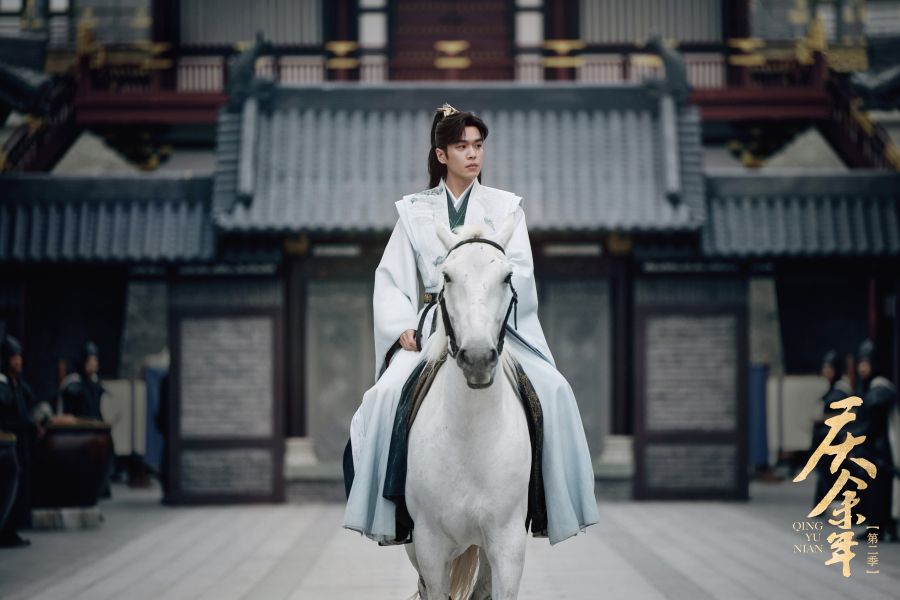
In episode 27, the matter at hand now is the 20million taels of silver that the Royal Or Imperial Treasury is in the red for, thanks to a certain Princess Royal. She fully intends to use this massive hole to cause trouble for Fan Xian. In the second half of episode 26, we see that Fan Xian went to visit the Hall of Joy. It was, you could say now a guild of merchant shopkeepers or really shop managers that was first created by Fan Xian’s mother and helped run the imperial treasury back in the day. The idea was to use these managers to basically extort various shop owners that they manage properties for to cough up the necessary 20 million taels of silver.
However, Fan Xian adamantly refused this and instead, prioritizes going on a honeymoon with Wan’er as newlyweds. This confuses everyone including the Emperor when Fan Xian requests for this time off. Interestingly, it was the Emperor who told Chen Ping Ping to give Qing Yu Tang or the Hall of Joy as a tool to help plug this hole. Even he, the Emperor, was surprised to see Fan Xian completely refusing this help. They’re confused as to how on earth Fan Xian is so nonchalant about such a huge debt problem.
With that, Fan Xian, Wan’Er and for some reason, Fan Si Zhe and Ruo Ruo are brought along to this honeymoon all the way to Cang Mountain. This place has historical ties to Fan Xian’s mother, Ye Qing Me,i and is where Uncle Wu Zhu told Fan Xian to go to get more clues about the past.
This honeymoon is not simply just a honeymoon. Instead, it becomes an investor meeting for government bonds. Fan Xian instructs Fan Si Zhe to send an invitation to all of the business owners in the Capital to come visit him in Cang Mountain as Fan Xian received the list from the managers from the Hall of Joy. Now, these shop owners all know why they’re being called there. Everyone in the Capital somehow knows that Fan Xian has this massive gap to fill in the treasury. These shop owners in a spa,and did you catch the name of the spa? 3 9 spa aka, the 999 medicine sponsored spa, an ad placement, all colluded to say nope, we’ll maybe give a little bit of money as a wedding present but then there’s no way they’ll cough up enough to amass 20mm taels.
In Cang Mountain, the honey moon ends up being basically an investor meeting where Fan Xian starts pitching Qing government bonds. It even comes with a powerpoint! This is pretty much what companies and governments have to do if they are trying to sell their debt to investors. Corporations sell debt or the term is actually issue debt in order to help fund certain activities. That is the same for governments or sovereigns.
Fan Xian’s little investor pitch tries to tie in the wealth and future trajectory of the Qing kingdom to try to entice these shop owners into buying the physical bonds that he is trying to offer. But, they all seem rather reticent. Government bonds is an entirely new concept and it’s understandable that there’s a lot of skepticism. Fan Si Zhe arrives with the giant plaque that the Emperor gave to Fan Xian for his wedding that wishes Fan XIan and Wan’Er a hundred years of happy matrimony. This is to signal to these would be investors how closely tied Fan Xian is to the Imperial Family as a signal to the reliability and trustworthiness of Fan Xian’s words. The main concern for investors, which makes sense is, what happens if Fan Xian were to be demoted or lose favor. What if their investments go bad because of Fan Xian? This plaque is a signal to how strong these investors should put their faith in Fan Xian.
Fan Xian and Fan Si Zhe wrapped up their investor pitch and now we’ll have to see whether or not these shop owners bite. They all definitely have their own investors that they have to consult with, but the wheels are turning for these men.
The other main thread in the episode is Ruo Ruo and Wu Zhu. Ruo Ruo is now fully learning how to be a surgeon given her exceptionally steady hands. On the moving carriage to Cang Shan she is practicing how to dissect a frog and then in Cang Mountain she practices removing seeds and sewing up grapes. But she is now going to be given another task.
Wu Zhu seeks out Ruo Ruo and they formally meet in the manor of Cang Mountain. Here, he give Ruo Ruo access to THE sniper rifle that was in the mysterious case that Ye Qing Mei left to Fan Xian in season 1. We actually never saw the actual sniper rifle in season 1 but we now get actual screen time to this weapon. We also learn that there is a component that is missing from the suitcase so the weapon is not fully useable. But, Wu Zhu wants Ruo Ruo to learn how to use this weapon in order to protect Fan Xian from either grandmasters or even him, Wu Zhu. This weapon is probably the only thing strong enough to fend off someone as powerful as a grandmaster. Ruo Ruo has exceptionally steady hands which makes her the perfect candidate to hold the sniper rifle.
We’ll leave the episode recap here. Before moving on to pop culture and historical references, let me spend a few more moments on the bonds that Fan Xian was trying to sell.
First of all, one slight correction. I’m reading the youtube translations and it calls this debt or these bonds, treasury bonds. I guess I understand that in the context of this drama where we are calling Nei Ku as the Imperial Treasury, it makes sense to call these bonds treasury bonds for government bonds issued by the Qing treasury. But Treasury bonds as a whole with a capital T only refer to bonds issued by the United States Treasury. Instead, the overarching term should just be government bonds. Government bonds from the UK are called Gilts, from Germany, called Bunds, from Japan, JGBs or Japanese Government Bonds.
Obviously, the investor presentation was already simplified to try to just introduce the concept of buying government debt. Countries do this all the time and the US itself also issues debt constantly. There are concerns obviously around the sustainability of how much national debt there is and those concerns have triggered selloffs and what not but government bonds are foundational to fixed income capital markets globally.
The idea is that you as a buyer of the bond lends money to the bond issuer, in this case the Qing kingdom. In return, the Qing kingdom will give you some interest as a reason TO lend the money. Fan Xian mentioned that briefly in the episode but the interest is crucially important to why investors would want to buy a bond from a corporate or a sovereign. Other features of a bond also includes maturity which is something Fan Xian did NOT really emphasize. Bonds are issued at different maturity dates which can range from just a few months to a few years. Obviously, investors can buy in and sell out of different bonds at any time, but if you chose to buy a 5 year maturity US treasury bond, that will mature in 5 years where you are paid interest for the duration of the 5 years and then the full principal when the bond matures.
There are other concepts that are crucial to how this works and some of that is hinted at in the next episode so I’ll elaborate there. But Fan Si Zhe is correct in trying to emphasize Fan Xian’s ties to the Imperial family because one of the big reasons for why interest rates and even maturity lengths of how long bonds are issued, are heavily based on the ability and willingness to pay by the bond issuer.
Anyways – a lot of finance jargon today. Let’s move onto the pop culture and historical references.
When the finance institutions owners are at the men’s spa. There’s a plaque that says the spa is called 三九堂 or 39 Spa. This is another clever product placement for the 999 感冒灵 or Chinese herbal medicine. There’s 3 nines to it and so the spa is called 39.
At the spa, these owners are adamant that they won’t be caught in Fan Xian’s shenanigans and believe that the 青天 of the Imperial Censorate will get enough dirt on Fan Xian to take him down. These men keep referring to the Imperial Censors as Qing Tian. What does that mean?
Qing Tian – means a cloudless sky. 青 also sounds like 清 which means clear / clean. Qing Tian often refers to clean officials who are not corrupted and actually do good for their subjects. In Chinese culture, the most famous example of 青天 is 包拯 or more commonly known as Bao Qing Tian.
He was a politician and scholar during the Northern Song Dynasty and lived from 999 CE to 1062 CE. Bao Zheng became a Jin Shi in 1027 and gradually rose to the position of Censor. During his career, he advocated for reforms to “tighten” up the government including strict selection of officials, the dismissal of corrupt, lazy, or weak officials, mandatory retirement for aged officers. He served in various posts, including judge of the Ministry of Revenue, vice minister of the Ministry of Revenue, and head of the Censorate. He repeatedly impeached powerful figures and advised on reforms. In 1061, he was promoted to deputy grand councilor.
Bao Zheng was renowned for his incorruptibility and impartiality when judging cases. He earned the titles “Bao Qingtian” and “Judge Bao,”. He was later venerated as a deity, believed to be the reincarnation of the star Kui. After his death, tales of his case-solving circulated widely. There were several stories written about him shortly after his death and into the Southern Song Dynasty. As a note though, these are just literary imaginations at this point. During the Yuan dynasty, given all the upheaval, many people wanted stability and thus Bao Gong plays appeared. In these plays, Bao Zheng is depicted as semi-divine, able to traverse heaven and earth, as he solved cases. In the Ming Dynasty, his depictions remained firmly human. He upheld imperial rule with righteousness. In the Qing dynasty Three Heroes and Five Gallants, Bao Zheng’s image was further solidified, showing him as fearless, upright, and capable, with detailed backstories, legendary tools, and heroic subordinates.
In Chinese Opera, the character frequently appears on stage as Bao Zheng. These operas are collectively called “Bao Gong Opera.” The operatic Bao is not the historical Bao Zheng but a literary, idealized version: a just, incorruptible, and exceptionally intelligent official, sometimes depicted as semi-divine. He’s quite common in Beijing opera. Bao Zheng’s operatic mask differs from traditional masks: black with a crescent-shaped white mark on the forehead, known as the “moon-shaped forehead”.
In modern day Chinese dramas, he’s had several really popular dramas. Who doesn’t love a good case-cracking drama? As I mentioned earlier, there’s the historical figure and then there’s the fictionalized character. Most people know about 包青天 who lived during the Northern Song Dynasty but not his historical details.
Next is a fun little pop culture reference, or at least I think it is. This happens during the finance conference when Fan Xian introduces the concept of bonds to the finance managers. He has all these fancy “slides” for his makeshift powerpoint. Fan Xian says the phrase 见证奇迹的时刻 or “It’s time to witness a miracle”. The phrase is a perfectly fine phrase and definitely used in all sorts of conferences. What immediately jumped out in my mind though was the Magician Liu Qian saying this phrase way in the early 2010s during the televised Spring Festival Gala. Liu Qian is a magician from Taiwan and he was invited to perform magic tricks during those years. Each year, he would perform his trick, stunning hundreds of millions watching TV and his catchphrase was 见证奇迹的时刻到了 or “It’s time to witness a miracle”. We talked about him in the 2024 and 2025 Spring Gala episodes because he made a return during those two years. I believe he did use those catch phrases too. The magic tricks during those two years were quite memorable because in 2024, Liu Qian’s partner in crime, the host 尼格买提, messed up the magic trick. He had his redemption in 2025. Maybe because the catchphrase is so memorable, my mind went directly to thinking that the drama gave a nodding wink to this reference.
Lastly, in the episode, in an effort to placate the suspicious financial owners, Fan Xian brings up the point of 人存政举 人亡政息 or when a man remains, the policies are carried out. When the man dies, the policies cease. The phrase comes from The Doctrine of the Mean (Liji · Zhongyong), written over 2000 years ago, in which Confucius informs Duke Ai of Lu 鲁哀公 that 文武之政,布在方策。其人存,则其政举;其人亡,则其政息.
“The governance of Zhou Kings Wen and Wu is recorded in written texts for dissemination. When the man remains, the policies are carried out; when the man is gone, the policies cease.”
This indicates that although the policies of Kings Wen and Wu were preserved in classical texts, the implementation of the policies and governance still depended on capable officials.
As was discussed in the drama, if Fan Xian’s alive, sure the bonds will have meaning, but what if he loses favor? I interpreted the actual text more as, oh you need good people to enact laws, rather than oh if a person dies or loses favor, the policies won’t happen any more but all that can be true.
–
Let’s conclude with book differences! As I said in the previous podcast episode, in the book, the Imperial Treasury doesn’t have a massive hole that Fan Xian needs to plug so he doesn’t have to have a marketing conference. Fan Xian DOES have to interact with many finance managers in the book but in a different manner. His time at Cang Shan was just a chill honeymoon. Well – he also spends time practicing with the sniper rifle. That’s right, in the book, Fan Xian first starts practicing with the gun. Wu Zhu does indeed pick Fan Ruo Ruo as his disciple to become a sniper but that doesn’t happen until later on. I personally find it frustrating because literally all the other female characters besides Wan Er have a more interesting plot line.