
[Cathy]
We are in the end game!!!! We have a whole setting shift now which is super exciting!!! But before that, we’re still at a secret meeting between Fan Xian and the Emperor where now, the Emperor exhibits quite a bit of tenderness in front of Fan Xian. Fan Xian actually showcases his fantastic acting chops by acting confused about this level of care from the Emperor and says that he is confused about who his father is. The Emperor crosses his hands in a rather proud way and simply responds “Is that something you really need to ask?”. Fan Xian then continues to act shocked at this news. We know that he has known for quite some time who his true parentage is, but in front of the Emperor, he cannot betray that knowledge. The Emperor seems pleased by this reveal and advises Fan Xian to head down to Jiang Nan to see what Ye Qing Mei left the world. He then departs.
That night, Fan Xian and Ruo Ruo discuss what happened today. Fan Xian is terrified of this revealed connection because it seems like the Emperor has spent this entire time evaluating whether or not Fan XIan is worthy of being his son, rather than just outright welcoming him as his son. It means that everything he does is being watched.
We turn to the next day. Wu Zhu is heard calling for Wan’Er at the Fan Residence. The timing of this meeting is very interesting. They have never met face to face and this comes at a time when Wan’Er has learned that Wu Zhu was the one who killed her brother. But, she can tell he is seriously injured as he urges her to tell Fan Xian, in a very robotic voice, that Fan Xian needs to go to Jiang Nan to visit the 3 Great Workshops. In a very emotional exchange since Wan’Er finally meets the person who murdered her brother, she tearfully states that she will not kill Wu Zhu at this moment because Fan Xian needs him. But once Fan Xian no longer needs him, she will take his life. Wu Zhu, recognizing how trustworthy she is in relation to Fan Xian’s safety, agrees.
[Karen]
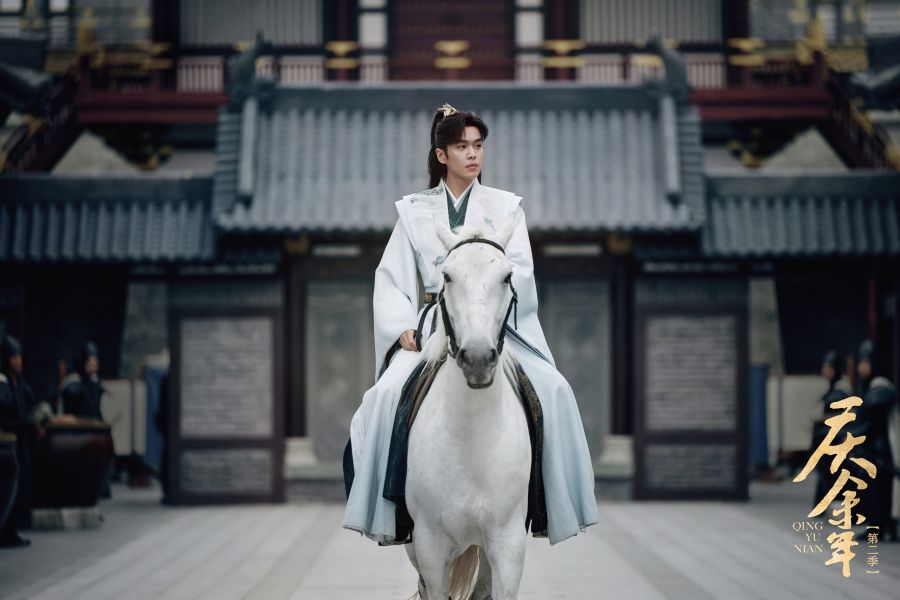
Well, it looks like all signs point to need to head down south so now, with Fan Xian recovered from his injuries, it is time for him to take the journey to Jiang Nan. On the ship before departure, several people show up to send him off. All of his now “brothers” aka the princes are there. The first prince, the 2nd prince, the crown prince and the 3rd prince. Fan Xian’s father and Mistress Liu are also there to send him off. In front of this crowd, he makes the bold declaration that when he returns, he will head to the Fan family ancestral hall. This is customary for family members of the Fan family and he has not yet done that since coming to the capital. This statement is important because, as the 1st prince notes, if Fan Xian does that, he will truly be part of the Fan family. The underlying subtext is that he forgoes any claim to the royal family, and the throne. Fan Xian doesn’t bat an eye and just responds, he originally has the name of Fan. Awwww he knows which family is truly treating him as a family rather than the one that is nothing but chaos and manipulation.
The respective groups say their goodbyes, with the princes giving Fan Xian a toast and Fan Xian giving his parents a warm hug before leaving. The 3rd prince is given permission to join Fan Xian on his journey so he tags along. On the boat before departure, Fan Xian is rather restless and finally steps out of the rooms to the deck. That is where he sees his wife, Wan’Er on the dock waiting to give him a final send off as well. They certainly have their marital issues right now given the fallout of her brother’s death, but she still opted to say good bye. The two share a tender air hug and Fan Xian departs.
Now is where the fun begins. The group including Wang Qi Nian and student Shi Chan Li is amongst the entourage with Fan Xian. The moment they start heading out, there are throngs of small boats carrying individuals that announce themselves as underlings of various government officials. They are all here with their gifts from these officials they would like to give Fan Xian. You know, as a way to bribe Fan Xian. Fan Xian instructs Wang Qi Nian to not object and just documents every single gift that was given to him. But, it is not all fun and games for Fan XIan. Clearly, there is a group that doesn’t want him to succeed in his endeavors in the south.
[Cathy]
That group? Well, it’s the second prince and the Ming family itself. The second prince apparently sprinted over to meet with the wealthy Ming family who oversees the 3 Great Workshops in Jiang Nan. They are allied with the Princess Royal and of course, they must conspire against Fan Xian in order to make sure the valuable 3 Great Workshops do not return back to Fan Xian’s hands. We meet Ming Qing Da, the elderly son of the Ming Family. More importantly, we meet the oppressive Matriarch Ming, the grandmother of the Ming family. She arrives and immediately exudes an imposing pressure. Her son, Ming Qing Da, even shrinks at her presence. This Ming family is an odd one. Despite overseeing extravagant wealth, Ming Qing Da is dressed in tattered garbs and his mother even opts to help fix the holes in his sleeves herself.
Anyways, the 2nd prince is here to pressure the Ming Family to NOT turn the workshops over to Fan Xian. While the Ming Family quickly agrees, the 2nd prince ensures his point is made by revealing that he has cut off the escape route if indeed the Ming family were to change sides to Fan Xian instead.
What did he do? He hired a bunch of poor, destitute and mostly senior civi lians on a suicide mission to attack Fan Xian’s ship. Or more accurately, placed a bounty on behalf of the Ming family to kill Fan Xian. Of course, this is all done by the 2nd prince to force this fight between the Ming Family and Fan Xian. Such a low blow tactics wise.
[Karen]
These civilians head to the side of the ship and start hacking away which amuses and confuses Fan Xian. Instead of attacking them, he actually invites them up to figure out exactly what is going on. Turns out, these individuals are refugees who have fled to Jiang Nan after disasters in their hometown. The MIng Family helped give them food and shelter in exchange for work. But they have no money to return home. Because this bounty is attacking an official trip, these poor refugees with no other option, are sacrificing themselves in order to get money for their families so they can potentially live a better life. Hmm…. Wow. Again, what a low tactic from the 2nd prince.
But it doesn’t look like the Ming family is actually that good. The Matriarch retreats with the head of the Ming family, her son Ming Qing Da. He deduces that someone in the Ming family likely betrayed them and worked for the 2nd prince. There is no other way the bounty could have been sent out on behalf of the Ming family. In an absolutely CRAZY twist, the Matriarch just drops the pouch of needles that she used earlier to sew up his sleeves. The punishment? EEEEK. Wince induce for how painful it is. Ming Qing Da knows that he needs to stab each of his own fingers with a needle. THAT is the iron fist with which the Matriarch runs the family. So…yea. Does not seem like this will be an easy foe to win against for Fan Xian at all.
In the next episode, we will see more of this new adversary and the indeed ruthless and bloody actions this family takes to impede Fan Xian.
–
Let’s move on to the history found in this episode!
[Cathy]
祠堂
Ancestral halls known as 祠堂、宗庙、祖庙、祖祠 are core institutions in Chinese society, serving as spaces for ancestral worship, family governance, and the preservation of Confucian values.
The origins of the ancestral hall system date back to the Zhou Dynasty, over 2500 years ago, when formal ancestral temples were reserved to just the Sky Ruler or the King. The term Ci Tang appeared during the Han Dynasty, over 2000 years ago. From the Qin and Han periods into the northern Song Dynasty, 1000 years ago, these ancestral temples were reserved for the ruling elite. Commoners were prohibited from constructing such spaces. We’ve seen variations of these ancestral halls in the different dramas but most prominently in The Story of Ming Lan.
A major shift occurred during the Southern Song Dynasty, when the influential Neo-Confucian scholar Zhu Xi 朱熹 advocated for the establishment of family ancestral halls that was broader than just for the elite. He formalized the practice in his work Family Rituals (家礼), proposing that each lineage maintain a hall to honor up to four generations of ancestors. This marked the beginning of broader, though still limited, adoption and usage of ancestral halls.
During the Ming Dynasty, state policies further expanded the role and accessibility of ancestral halls. Crucially, in 1536 under the Jiajing Emperor, an imperial decree known as the “Edict of Extended Grace” (推恩令), proposed by minister Xia Yan 夏言, officially relaxed restrictions on ancestral worship. This legitimized the construction of ancestral halls among common people and accelerated their spread throughout society.
From this point onward, ancestral halls became multifunctional centers where clan authority and spiritual practice intersected. They were used not only for rituals and offerings but also for managing family affairs, educating descendants, and reinforcing moral values. Often the most prominent and elaborately constructed buildings in a community, they stood alongside temples, bridges, and pagodas as key cultural landmarks.
There are existing Ancestral halls still standing dating back to hundreds of years but many were destroyed during the cultural revolution in the 1960s and 1970s. There’s one in Guang Dong that dates back to 1406. Even now, the Chinese, especially in the south, do spend a great deal to maintain and rebuild the ancestral halls.
Ci Tang or Zong Miao are extremely common tropes in Chinese romance novels and dramas where individuals are sent to pray to their ancestors as punishment for misdeeds.
族谱
Chinese genealogies (jiāpǔ or zúpǔ) are invaluable cultural records that document lineage, kinship, and family history. At their core, genealogies reflect the enduring influence of Confucianism, particularly its emphasis on ancestry, hierarchy, and familial continuity. Despite their importance, genealogies can’t be treated as an undisputed fact. Historians note that wars, dynastic transitions, and social upheavals, especially following the collapse of the Tang Dynasty and the turmoil of the Five Dynasties and Ten Kingdoms period, led to the near-total loss of earlier records. As a result, many genealogies were later reconstructed, sometimes with gaps filled through speculation or deliberate embellishment, including claims of descent from famous figures.
Before the Song Dynasty, genealogies were primarily compiled by the state and used for official purposes, such as selecting government officials and verifying the status of elite families in marriage alliances. Many important families, such as the famous 5 Surnames and Seven Clans or 五姓七望 which were aristocratic families that held considerable influence in China for almost 700 years from the Eastern Han Dynasty in the 3rd century all the way to the fall of the Tang Dynasty in the 10th century also held close tabs on their own family genealogy. The influence of these families were wiped out quite literally because Huang Chao, a salt trader and soldier, instigated a rebellion in the late 9th century. Legend has it, he took note of these influential clans, which were readily available based on name, status etc, and ordered his men to just slaughter them. I don’t know if he just took the family genealogies and murdered them based on that, but his actions were a HUGE blow to the aristocratic families of old in China.
From the Song period onward, however, private compilation became increasingly widespread. Genealogies shifted in function toward organizing lineage (tracing descent), clarifying generational hierarchy, distinguishing degrees of kinship, and promoting values such as honoring ancestors and maintaining clan unity.
By the Ming Dynasty, genealogical compilation had reached a mature and standardized form, establishing structural conventions that would persist for centuries. The subsequent Qing Dynasty and the Republic of China era marked the peak of genealogical development, with large-scale revisions and the emergence of professional “genealogy compilers” (谱匠) who specialized in constructing and updating family records. Most surviving genealogies today date from the Ming and Qing periods, and tens of thousands are preserved in libraries worldwide, with many more still held privately across China.
One of the most famous examples is the genealogy of the descendants of Confucius, often called the 天下第一谱 “No. 1 genealogy under heaven.” First compiled in 1085 during the Northern Song by a 46th-generation descendant, it was continuously revised through the Ming and Qing dynasties under imperial patronage. The Qing established a formal system of periodic revisions every 60 years, and by the Republican era, the genealogy had expanded into a nationwide record encompassing dispersed descendants. A modern revision in 2009 further broadened its scope to include women, ethnic minorities, and overseas descendants, reflecting evolving social values. At the same time, earlier editions included strict entry requirements, excluding individuals deemed unfilial or those in certain professions, highlighting the moral and social functions genealogies once enforced. I went to visit Confucius’s family shrine in Qu Fu, Shan Dong china, and the main takeaway from the tour is just HOW steeped in family, tradition, and culture the Kong family is. They were tracking like the 80 something generation of Confucius. It was quite an experience to be standing in these grounds and be physically present near something that has had an uninterrupted line for over 2000 years. Yeah – i mean the buildings were all renovated over the years, but still, it was quite cool.
In the context of the drama, if Fan Xian prays to the Fan Ancestral Hall and is formally added to the Fan family genealogy, then he will forever forfeit his claim to the throne. Think back to the Empresses in the Palace or the Story of Yan Xi Palace. The Emperors in those dramas make mention of having their concubines and children have the 玉蝶 or imperial genealogy. Different era, but same concept. Fan Xian cannot be named a prince if he isn’t formally in the Imperial genealogy. By choosing the Fan family, he will never have a claim to the throne.
执鞭坠镫 – zhí biān zhuì dèng
The 3rd Prince makes mention of this as he says he will follow his teacher wherever. this phrase originally referred to attending and serving someone while they were on horseback. It later evolved into a metaphor meaning to willingly follow someone out of admiration or respect. The idiom comes from 水浒传 Water Margin written by Shi Nai’an during the Ming Dynasty.
地头蛇 (dì tóu shé)
Literally meaning “local snake,” this term refers to a person or force that holds real power in a particular area, often translated as “local bully.” It first appeared in 醒世恒言 Stories to Awaken the World by Feng Menglong 冯梦龙 during the 17th century.
The term carries a dual meaning:
It can refer to local tyrants who oppress others through force or power, for example, figures who engage in extortion, coercion, or organized criminal activity.
It can also more neutrally describe individuals who possess strong local influence or control within a specific region.
The phrase is widely used in Ming and Qing literature. For instance, Journey to the West published in 1592 includes the saying “a powerful dragon cannot overpower a local snake,” illustrating the limits of outside authority when faced with entrenched local power.
Lastly, let’s conclude with book differences.
In the book, the Emperor DOES acknowledge that Fan Xian is his son after he recovers from his injuries. They do have a heartfelt moment where the emperor informs him of his birthday. The Emperor also shows him a portrait of his mother. Fan Xian stars at the portrait separately and comes to the conclusion that his mother must have been a PHD in the sciences. Fast forward to Fan Xian’s departure. There’s some sidebars that happen in the book such as meeting the Ye family managers again. The drama includes this parting party for several characters such as the princes and the fan family. Because Fan Xian and Wan’Er don’t have a falling out, there isn’t the separate scenes with Wan Er and Wu Zhu or the goodbye between Fan Xian and Wan Er at the dock. Fan Xian’s travel down to Jiang Nan also is rather long and superfluous, taking care of bandits and bribes. The drama takes a different direction here. The 2nd Prince does not make it down to meet the Ming Family and we don’t get all this back story from the ming family. It’s great that the drama was able to cast Gui Ya Lei as the formidable Madame Ming. We don’t get too many scenes with her but she’s always a treat on screen