
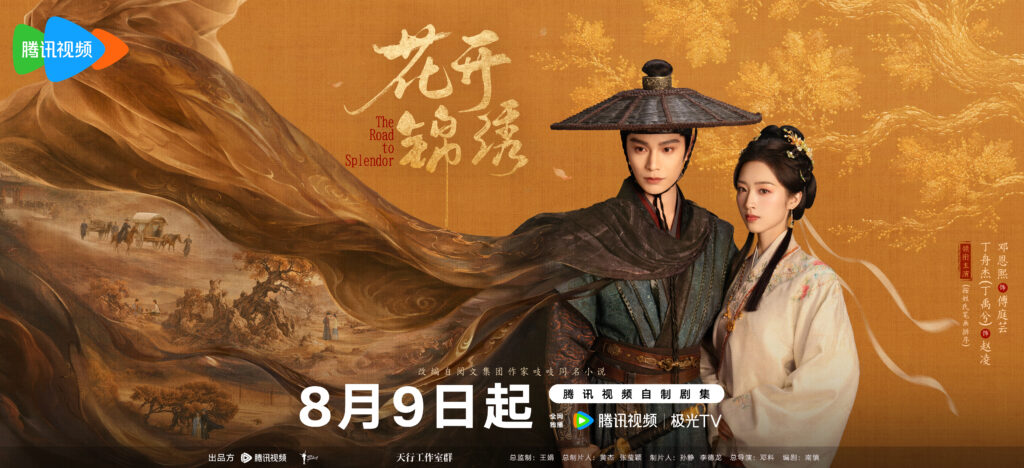
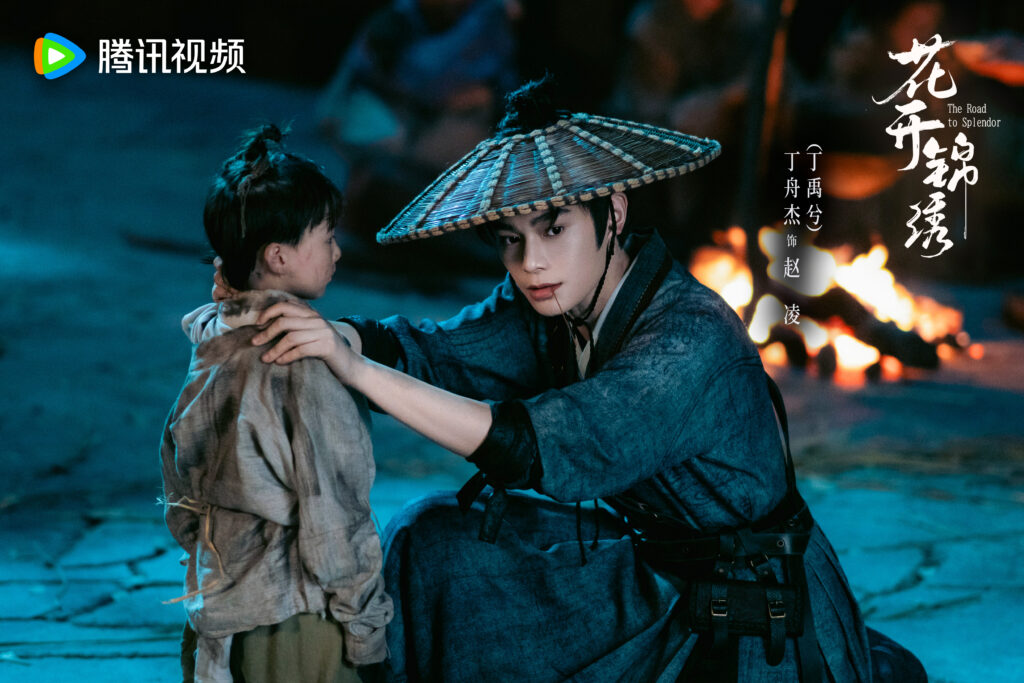
Background and history on The Road to Splendor Ft Ding Yu Xi and Deng En Xi
Ming Dynasty Setting
Although the drama never explicitly identifies its historical period, the customs, clothing, political structures, and social practices all strongly point to the Ming dynasty, which ruled from 1368 to 1644 CE. Based on the historical context portrayed in The Road to Splendor, the story appears to take place in the late 15th century, around the reign of the Hongzhi Emperor, 弘治帝, who ruled from 1488 to 1505.
Now, is everything in the drama historically accurate? Absolutely not. There are certainly scenes, details, and storylines that take some creative liberties with history.
But rather than focusing on everything the drama gets wrong, today we want to highlight the areas where The Road to Splendor draws meaningfully from Ming history and culture and where those historical details actually make the drama more interesting.
So today, we’re going to dig into some of the history behind the story, the characters, the costumes, and even some of the visual symbolism that you may have missed while watching.
Importance of Salt
By the Ming dynasty, salt had become much more than a commodity. It was a tool of government policy.
One of the key terms in the drama is 盐引, yányǐn, which we’ll translate as a salt certificate. Essentially, it was a government authorization allowing a merchant to obtain and sell a certain quantity of government-controlled salt.
And this brings us to one of the most important policies of the early Ming: 开中法, or the Kaizhong system.
When the Ming was founded, the government had large numbers of soldiers stationed along the northern frontier, where the Mongol threat remained significant. Those soldiers needed grain, but transporting grain from China’s agricultural regions to the frontier was extremely expensive.
So around 1370, the government essentially outsourced the problem to merchants. A merchant would purchase and transport grain to a designated frontier military warehouse. In return, the government gave him a salt certificate. He could then obtain government salt and sell it in an assigned market.
It was a clever system because the government got its grain, while merchants got access to a highly profitable state-controlled industry.
This helps explain the rise of the 晋商, or Shanxi merchants. Shanxi’s location near the northern frontier gave its merchants a natural advantage, and some accumulated enormous fortunes through salt trading.
But there was a catch: their wealth depended on a privilege granted by the government.
Over time, the salt system became increasingly dysfunctional. The government issued too many salt certificates while actual salt production remained limited. Merchants could hold legitimate certificates but be unable to obtain the salt they had been promised. Corruption and preferential treatment made things worse. That meant illegal salt or private salt, or in the drama 私盐 became increasingly widespread. At the beginning of the drama, Zhao Ling has deep ties to the illegal salt trade. Then there are families such as the Yan family and the Yu family who use their influence to engage in corruption.
And that’s where 盐政, yánzhèng, comes in. Salt administration wasn’t just about selling salt—it involved production, distribution, taxation, merchant privileges, and enforcement. Whoever controlled the salt system controlled a significant source of both money and political power.
During the reign of the Hongzhi Emperor, 1488–1505, the government tried to reform the system. In 1492, the official Ye Qi, 叶淇 Ye Qi, introduced the 折色法 Zhe Se Fa. Instead of merchants transporting grain to the frontier in exchange for salt privileges, they could pay silver.
This improved the government’s access to revenue, but it also created a new problem: silver doesn’t feed soldiers. The government still had to purchase and transport grain to the frontier.
And this is where Zhao Ling fits so neatly into the historical story. He understands the salt trade from the merchant side, but he also becomes involved with the military and the frontier. So when he gets involved in salt reform, he understands both sides of the problem: the emperor needs revenue, but the military still needs supplies.
That makes the salt reform more than historical background. It becomes one of the drama’s central political and economic tensions.
And salt also explains the wealth behind many of the powerful merchant families we see in the drama. Salt trading could provide the initial capital that families later diversified into businesses like tea, textiles, transportation, and finance.
So when we see these wealthy merchant families competing for money, status, and influence, remember that underneath the family drama is a much larger system.
盐引 The Salt Certificate wasn’t just a piece of paper. It was a mechanism for distributing economic privilege.
The government used salt privileges to obtain what it needed. Merchants used those privileges to build fortunes. And those fortunes eventually became family and political power.
That’s what makes salt such a fascinating part of The Road to Splendor: it connects the emperor, the military, the government, the merchants, and the families at the center of the story.
Chastity Archways
Next, let’s turn to another historical element that makes the drama’s visual storytelling much more meaningful: 贞节牌坊 Zhen Jie Pai Fang, or chastity archways.
This wasn’t yet the elaborate chastity archway system we associate with later China, but it represents an important early precedent: the public and state recognition of female chastity.
Over the centuries, that recognition became increasingly institutionalized. A woman’s chastity could bring honor not only to herself, but to her husband’s family—and conversely, accusations against her could bring shame upon the family.
Different categories of women could receive different forms of recognition, including 节妇, widows who remained unmarried; 烈女, women celebrated for preserving their chastity, sometimes through death; and 望门寡, women whose fiancés died before marriage and who nevertheless remained unmarried.
The exact rules varied across time and region, but the underlying principle was the same:
A woman’s personal choices could become a matter of family honor.
By the Ming and Qing dynasties, this system was deeply embedded in family and community life. Chastity archways could be beautifully carved and architecturally impressive, but they also commemorated a system that placed enormous restrictions on women.
And this is exactly what The Road to Splendor plays with.
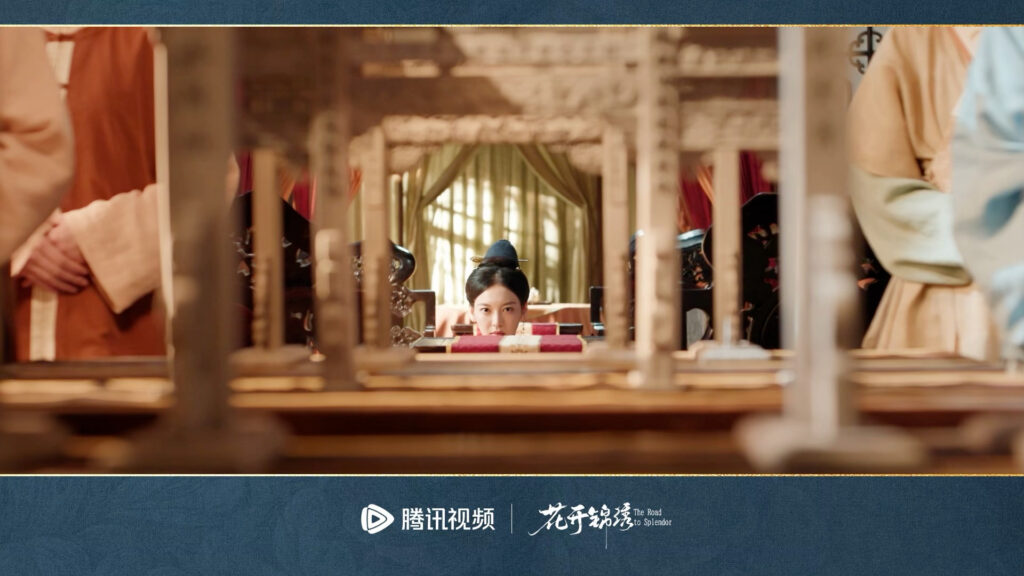
There’s a striking shot in the Fu family’s ancestral hall where three chastity archways are positioned one behind another. Their overlapping frames form something resembling the Chinese character 囚, meaning to imprison.
The symbolism is almost impossible to miss. These monuments are supposed to represent honor and virtue, but the women standing inside them look like prisoners.
The family gains prestige from these women’s sacrifices. The women pay the price.
That becomes especially important for Fu Tingyun. When she’s falsely accused of adultery, the threat isn’t simply to her own reputation. Her alleged loss of chastity becomes a threat to the honor of her entire family.
And then the drama takes that symbolism even further. After Tingyun is condemned by her family and eventually rescued by Zhao Ling, she agrees to a fake marriage—but deliberately holds the wedding on the same day as her funeral.
So we see two processions: red for the wedding and white for the funeral, eventually meeting at the Fu family’s chastity archways.
For Tingyun, this is essentially her symbolic funeral. What’s being buried isn’t simply her—it’s her old identity as the Fu family’s Ninth Miss, the daughter expected to live according to her family’s rules.
And then the archway changes meaning. Earlier, it represented a cage trapping generations of women.
Now, Tingyun passes through it. It becomes a threshold between her old life and her new one.
That’s why understanding the history of the chastity archway makes this imagery so much more powerful. The archway is beautiful from the outside, but from the inside, it looks like a prison.

Zhao Ling’s wedding outfits
The first time we see him wear a wedding outfit in episode one, he’s still a commoner. Under Ming dress regulations, commoners weren’t normally permitted to wear official robes. But weddings were an exception through a practice known as 摄盛 She Sheng, which allowed the groom to temporarily borrow the appearance of a higher rank.
The History of the Ming records that commoners could borrow a ninth-rank official uniform for their wedding. Ninth-rank officials wore blue-green, which helps explain why the groom could be called 新郎官 Xin Lang Guan, literally a “new official,” and why a wedding was sometimes called a 小登科, Xiao Deng Ke or “little examination success.” To this day, grooms are still called 新郎 Xin Lang.
And the drama gets clever with the details. Zhao Ling’s first robe is blue-green, but it isn’t actually a ninth-rank official uniform. Its decorative badge uses a sea-and-wave design rather than the seahorse motif associated with the official rank.
Later, everything changes.
By his second wedding, Zhao Ling is a fourth-rank official. Under the Ming system, first through fourth rank officials could wear crimson, while fifth through seventh wore blue-green and eighth through ninth wore green.
So his crimson wedding robe isn’t simply red because it’s a wedding. This time, he has actually earned the right to wear it.
His clothing has gone from symbolically borrowing official status to genuinely reflecting it. So the costumes aren’t simply beautiful period clothing. They visually document Zhao Ling’s rise from commoner to official.
East Bed Reference
And finally, there’s one more historical reference hidden in something as ordinary as where Yu Jingxiu’s bed is placed.
When Madam Yu first arrives at the Fu residence, the family puts her son in the east wing. She immediately moves him to the west. A few days later, she moves him back. Yu Jing Xiu complains that he can’t even decide where his own bed goes.
But historically, “east bed,” or 东床, has a very specific connection to marriage.
The expression comes from a famous story in the fourth-century 世说新语, A New Account of Tales of the World.
- An official named Xi Jian, 郗鉴, was looking for a husband for his daughter. He sent someone to the Wang family to choose among their sons. Most of the young men sat formally, trying to make a good impression. But one young man was lying on the east bed, casually exposing his stomach and eating as though nobody was evaluating him. Xi Jian loved his confidence and chose him. That young man was Wang Xizhi, 王羲之, who would become one of China’s most famous calligraphers.
From this story, 东床 or East Bed became a traditional term for a son-in-law, particularly an excellent one.
So when the Fu family puts Yu Jingxiu in the east wing, they’re effectively saying: this is the future son-in-law.
When Madam Yu moves him west, she’s saying: not so fast. This marriage hasn’t been decided. And her hesitation isn’t really about Fu Tingyun. She recognizes that Tingyun is intelligent, composed, and capable of becoming a strong matriarch.
Her concern is the Fu family itself. With the government investigating the salt case, associating her son with the family could damage the Yu family’s own political ambitions.
So one bed becomes a form of silent political negotiation.
East means: we’re considering this marriage.
West means: your family is too risky.
And when Madam Yu eventually becomes convinced of Tingyun’s character, the bed moves back east.
Once you understand the historical meaning of 东床, it’s no longer just a funny running gag. Madam Yu isn’t really moving a bed. She’s moving her son closer to—or farther away from—the marriage she is willing to accept.